Most people approach crystal buying the wrong way — they fall in love with a piece and then try to find a place for it. The result is a beautiful object that feels slightly out of place, like a painting hung in the wrong light. Choosing crystals for your home works better when you reverse the process: start with your space, understand what it needs, and let that guide your selection.
This guide gives you a framework for making that decision well. We'll cover the four questions every buyer should answer before committing, how to match crystal types to specific rooms, what size and scale actually mean for crystal decor, and the one factor most people overlook entirely.
The Four Questions to Ask First
Before you look at a single piece, get clear on these four things. They'll filter out 80% of the options and point you toward what will actually work.
1. What is the light like in this space?
Crystals are fundamentally light-reactive objects. The same rose quartz basin looks completely different in a bathroom flooded with natural north-facing light versus a powder room lit by warm 2700K bulbs. This isn't a minor consideration — it's the most important one.
Natural light amplifies translucency. If your space gets strong daylight, rose quartz and clear crystal pieces will glow. They catch and scatter light in ways that feel almost alive, especially in morning or late afternoon sun. Artificial light — particularly warm light — is kinder to darker stones. Smoky quartz and hematoid crystal look their most dramatic under warm tungsten or halogen-equivalent bulbs.
If your space has little natural light, lean toward translucent crystals that respond well to artificial lighting: clear crystal, rose quartz, and green quartz. If you have abundant daylight, almost any crystal type will work — but the translucent varieties will reward you most.
2. What is the dominant color palette?
Crystal is a neutral — but a highly specific neutral. Each type has a color temperature and undertone that either harmonizes with or fights against its surroundings.
- Warm palettes (cream, tan, terracotta, warm wood) — pair with rose quartz, hematoid crystal, or smoky quartz. The pink and amber tones extend the warmth naturally.
- Cool palettes (white, gray, blue-green, black) — pair with clear crystal, green quartz, or smoky morion. The neutral clarity of clear crystal and the cool sage of green quartz echo cool tones without competing.
- Neutral palettes (off-white, greige, natural linen) — the most flexible. Any crystal type works; choose based on how much color you want to introduce. Green quartz adds organic warmth; clear crystal adds visual lightness.
3. What visual weight do you want the piece to carry?
This is about presence, not size. A small hematoid crystal bowl with dramatic red veining can dominate a shelf. A large clear crystal basin can feel airy and almost invisible in the same space. Visual weight is determined by color intensity, pattern complexity, and opacity — in that order.
High visual weight: smoky morion, hematoid crystal, deep rose quartz. These pieces announce themselves. One is usually enough in a room.
Low visual weight: clear crystal, pale green quartz, light rose quartz. These pieces complement without competing. You can layer more of them into a space without creating visual noise.
4. Is this a focal point or an accent?
A focal point piece is what the eye goes to first — a vessel sink in a powder room, a large bowl on a dining table, a statement piece on an entry console. Accent pieces are supporting players: smaller bowls, bookends, objects on a side table. They reinforce the space's character without competing for attention.
If you're buying a focal point, pick the most visually interesting piece that works with your answers to questions 1-3. If you're buying accents, think about what will complement the pieces already in the space — similar material family, harmonious color range.
Crystal Choices by Room
Once you've answered the four questions, use this room-by-room guide to narrow further.
The primary bathroom is where luxury crystal decor has the most impact. You use this space daily, and the right piece transforms a functional room into something that feels like a private retreat. Crystal vessel sinks are the dominant choice here — they function as sculpture that happens to be a sink.
Best choices: rose quartz for warmth and translucency (particularly beautiful with floor lighting); smoky quartz for drama and a spa-like quality; clear crystal for versatility and a clean luxury aesthetic.
Rose quartz vessel sink — catches bathroom lighting exceptionally well, creates a warm, luminous focal point. Pairs with brass or matte gold fixtures for a cohesive luxury finish.
The powder room is the most visited room in a home by guests — and often the smallest. This combination makes it ideal for your most dramatic crystal choice. Because the room is small, a high-visual-weight piece doesn't overwhelm the space; it commands it.
Best choices: smoky morion or hematoid crystal for maximum drama; deep rose quartz for warmth and elegance. Clear crystal works especially well if you add uplighting beneath the vessel — the glow effect is striking in a small, enclosed space.
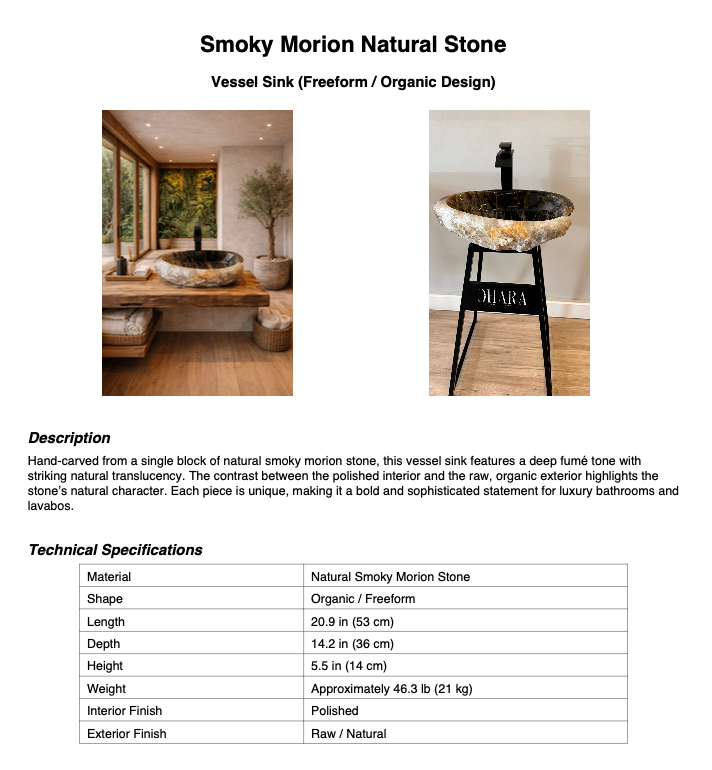
Smoky morion vessel sink on a white marble vanity — the dark crystal against white stone is one of the most visually powerful combinations in luxury bathroom design.
Living rooms call for pieces with staying power — you'll look at them every day, so they need to reward extended attention without being exhausting. Avoid high visual weight pieces as the only crystal in a living room; they work better as one element in a curated arrangement.
Best choices: green quartz bowls and spheres for organic, calming presence; rose quartz accent pieces for warmth; clear crystal for minimalist spaces where the crystal's internal landscape is the point.
Green quartz decorative bowl as a centerpiece — the sage tones work with almost any palette, and the organic irregularity of natural prasiolite rewards close inspection.
Entry pieces set the tone for everything that follows. The best crystal for an entry is one that makes an immediate impression — you're setting expectations, not building context. Something dramatic, beautiful, and unexpected.
Best choices: hematoid crystal for its dramatic veining patterns; smoky quartz for commanding presence; large clear crystal spheres or points that catch entry lighting and scatter it through the space.
Hematoid crystal bowl or point on an entry console — the iron oxide patterns look like frozen abstract art and invite closer inspection from every guest.
Getting Size and Scale Right
Crystal pieces fail most often because of scale errors, not style errors. A piece that's too small disappears; a piece that's too large overwhelms. Here are the size principles that prevent both mistakes.
A decorative bowl or vessel should occupy no more than two-thirds of the surface it's sitting on. For a 24-inch console table, that means a piece no wider than 16 inches. For a bathroom vanity, measure your counter depth and width, then choose accordingly — the sink should feel like it belongs on the surface, not like it's fighting for space.
For vessel sinks specifically, standard sizing runs 14–18 inches in diameter for round forms, and depth varies 4–7 inches. The piece should sit comfortably on your vanity top without overhanging the edges. If you're unsure, email us with your vanity dimensions and we'll identify which pieces in the collection will work.
For decorative pieces (bowls, spheres, points), the guiding principle is contrast. A small piece on a large surface reads as forgotten. A large piece on a small surface reads as crowded. Aim for your crystal to occupy one focal third of the surface — surrounded by negative space, not competing objects.
The Factor Most People Overlook: Finish Quality
Not all crystal pieces are finished to the same standard. Natural crystal requires significant hand-polishing to achieve the clarity and smoothness that makes vessel sinks functional as well as beautiful. There are three finish qualities to understand:
Raw finish — the crystal surface retains some of its natural roughness. Best for display pieces where water contact isn't a concern.
Semi-polished — the exterior is smoothed but retains some natural texture. Often used for the exterior of sinks, keeping the organic quality while ensuring the interior is smooth enough for use.
Full polish — the surface is brought to a glass-smooth finish throughout. Required for functional vessel sinks. This is the most labor-intensive finish and accounts for a significant portion of the piece's value.
All vessel sinks in the Lumera collection are fully polished on the interior basin surface. Decorative pieces vary by piece — check individual product descriptions for finish details.
Buying One vs. Building a Collection
If you're buying your first piece, buy the one that genuinely moves you — within your space constraints. The right first piece will tell you what direction to take next. If it's rose quartz, you'll naturally gravitate toward complementary warm pieces. If it's clear crystal, you'll likely want to build on its quiet versatility.
Every collector started with one piece they couldn't leave behind. That instinct is data. Trust it and build from there.
When building a collection, a few principles help. Work within one or two crystal families rather than sampling every type — cohesion matters more than variety. Vary the scale: mix one large statement piece with smaller accent pieces. And leave room — not every surface needs a crystal. The negative space around a piece is part of what makes it visible.
Natural Variation Is the Point
Every natural crystal piece will have natural inclusions, color variations, and surface characteristics unique to that stone. These are not defects — they're the record of 100+ million years of geological history embedded in the mineral. Two rose quartz sinks from the same quarry will have different pink intensities, different internal cloudiness, different veining patterns.
When you buy from the Lumera collection, you're buying a specific piece shown in the product photos — not a "type" that will be reproduced. The piece you see is the piece you receive. That's both the constraint and the value: there's no other one like it anywhere.
If a piece catches your attention, that instinct is worth acting on. The same geological conditions that created it won't produce an identical piece. Browse the collection with that in mind, and you'll find the right one.